Google Ads vs Meta Ads: Where Should Your Budget Actually Go

Google Ads vs Meta Ads: Where Should Your Budget Actually Go

Sneha Kapoor Sneha Kapoor
Jun 27, 2026 4 min read 3353 views

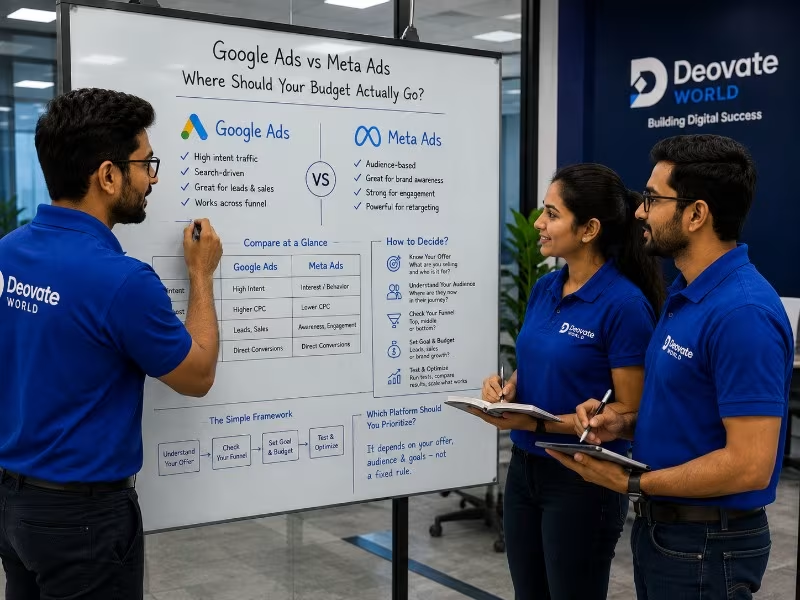
This is one of the most common questions from businesses starting paid marketing, and the honest answer is that it depends heavily on your specific offer, audience, and stage of growth, not a fixed rule that applies universally. Most of the generic advice floating around defaults to a simple recommendation without explaining the reasoning, which leaves businesses applying a rule that may not actually fit their situation. This article breaks down exactly what determines the right split, so the decision can be made based on your specific business rather than a borrowed rule of thumb.

The Core Difference That Actually Matters

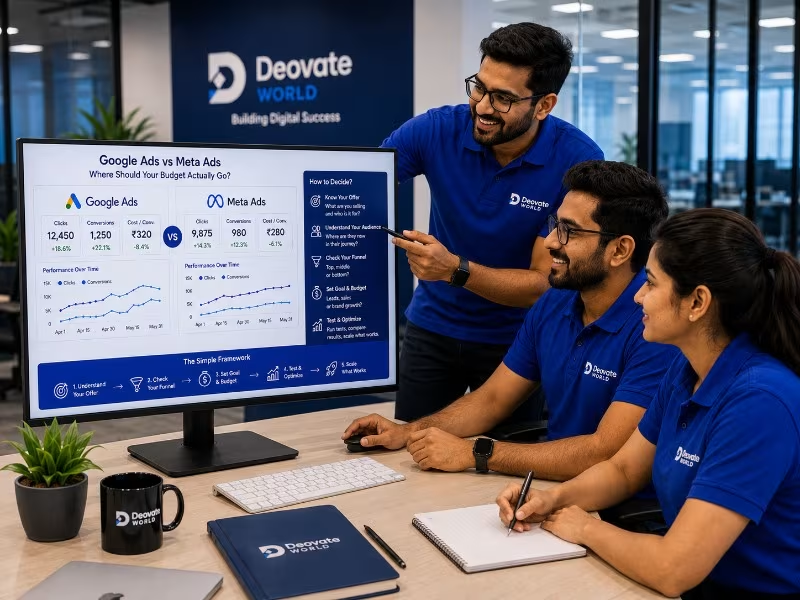
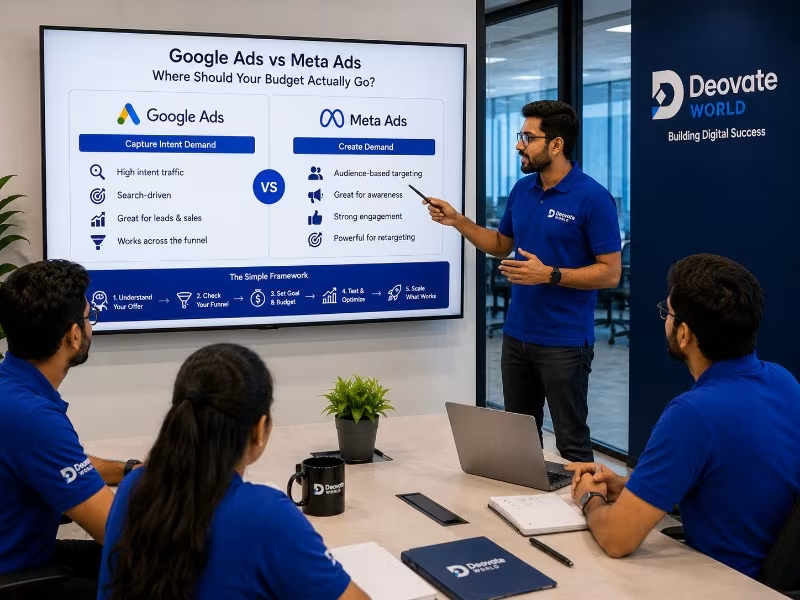
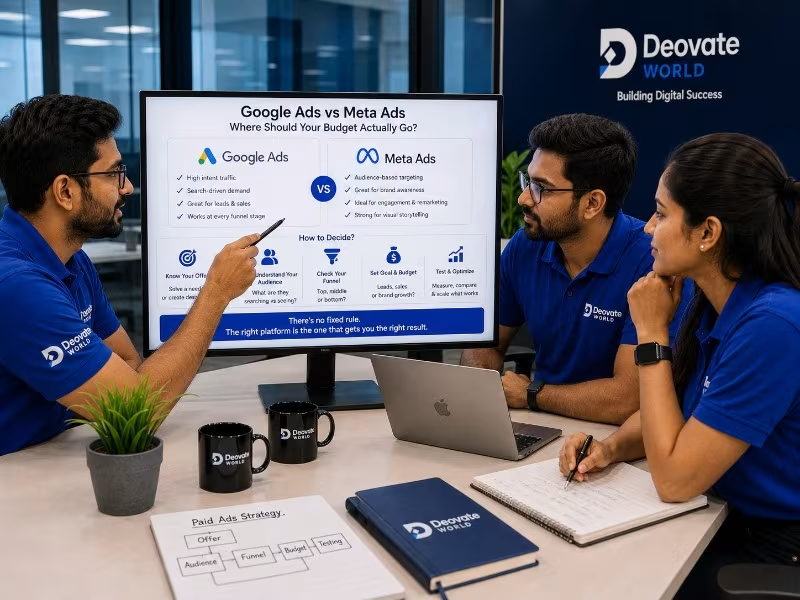
Google Ads captures demand that already exists. Someone is actively typing a search because they already have a need or a question, and your ad is competing to be the answer they click on, right at the moment of highest intent. Meta Ads, by contrast, creates demand by interrupting someone\'s scroll with something visually compelling before they were consciously looking for it at all. Neither approach is inherently better, they solve fundamentally different problems at different stages of a buyer\'s journey, and conflating them leads to poor budget decisions.

When Google Ads Wins

  • High-intent purchases where people actively search before buying, services, B2B solutions, urgent or specific needs
  • Products or services with a well-defined, known search term customers are already using
  • Situations where you need measurable, bottom-of-funnel conversions relatively quickly

When Meta Ads Wins

  • Visually appealing products that genuinely benefit from strong creative, most physical products fit this category well
  • Building awareness for a new brand or offer that nobody is actively searching for yet
  • Lower-cost, more impulse-driven purchases where a scroll-stopping ad can trigger a spontaneous decision

Budget Allocation Guide

Business Type Suggested Starting Split
B2B service or high-ticket consulting 70% Google, 30% Meta
Visual physical product (fashion, home goods) 40% Google, 60% Meta
New brand with low existing search volume 20% Google, 80% Meta
Established brand with strong search demand 60% Google, 40% Meta

Why Comparing Cost-Per-Click Alone Is Misleading

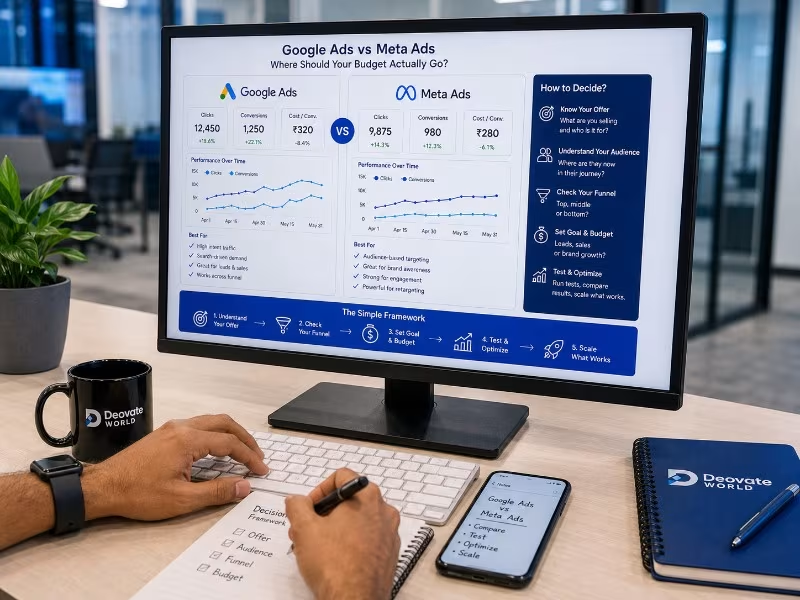
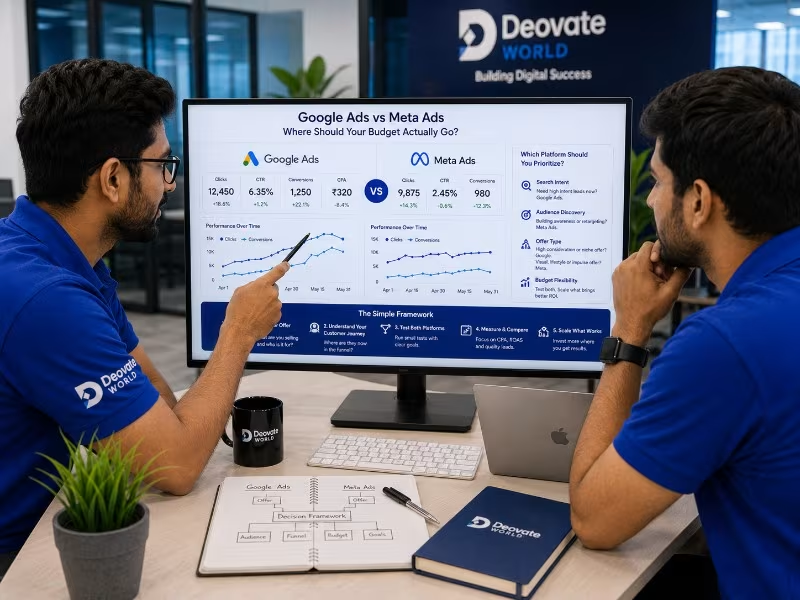
Businesses new to paid marketing frequently compare platforms by looking only at cost-per-click, and conclude whichever platform is cheaper per click is the better investment. This comparison misses the point almost entirely, because the two platforms are delivering fundamentally different types of clicks. A cheap Meta click from someone mid-scroll who has never heard of your brand is not equivalent to a more expensive Google click from someone actively searching with clear buying intent. The metric that actually matters is cost per qualified conversion, not cost per click, and those two numbers can rank platforms in completely opposite order.

The Funnel Stage Most Businesses Skip Thinking About

A common mistake is running Meta ads that attempt to sell directly to a completely cold audience, expecting the same conversion rate as a Google search ad targeting someone already in buying mode. That comparison sets Meta up to look like it is underperforming, when the real issue is a mismatch between the audience\'s awareness stage and the ad\'s call to action. Cold Meta traffic generally responds better to lower-commitment offers, a free resource, a short video, a simple newsletter signup, that builds familiarity before a direct sales pitch, rather than asking for a purchase decision from someone who saw your brand for the first time four seconds ago.

Testing Before Committing Serious Budget

Before allocating a significant monthly budget to either platform, a smaller test budget run over two to three weeks on each platform reveals far more than theory alone. Track cost per qualified lead or sale, not just cost per click or impressions, and be honest about sample size, a handful of conversions on either platform is not yet a reliable signal. This testing phase is inexpensive relative to the cost of committing a large monthly budget to the wrong channel for months before noticing the mismatch.

The Real Answer

Most mature marketing strategies eventually use both platforms deliberately, Meta to build awareness and generate demand among people who were not yet looking, Google to capture that demand once it matures into an active search. Treating the two platforms as competitors fighting for the same fixed budget, rather than complementary tools serving different stages of the same customer journey, is usually where businesses leave the most performance on the table.

Final Thought

The right allocation is never a permanent decision, it should shift as your brand matures, as search demand for your category grows or shrinks, and as you learn more about where your specific customers actually spend their attention. Revisit the split quarterly with real data instead of setting it once and forgetting it.

Gallery

Written by
Sneha Kapoor
Sneha Kapoor
UI/UX Designer
Have a project in mind?

Let's talk about how we can help bring it to life.

Contact Us
Leave a Comment

Share your thoughts on this article

Comments are reviewed before they appear publicly.

0 Comments

Be the first to comment on this article.

Keep Reading

More Articles

Brand Identity Mistakes That Are Quietly Costing You Trust

Brand Identity Mistakes That Are Quietly Costing You Trust

Most branding mistakes are not dramatic, they are small inconsistencies that quietly accum...

ERP vs CRM: What Growing Businesses Actually Need First

ERP vs CRM: What Growing Businesses Actually Need First

These two systems get confused constantly, and businesses often invest in the wrong one fi...

Why Skipping QA Testing Costs More Than It Saves

Why Skipping QA Testing Costs More Than It Saves

Skipping or shortcutting QA is one of the most common cost-cutting decisions teams make un...

Our Development Process

From Vision to Digital Success

Every project we take on moves through the same four stages, not because we lack flexibility, but because skipping steps is exactly how good ideas turn into messy builds. Here's what that looks like in practice.

01 Discovery
02 Planning
03 Development
04 Launch
Deovate/process

Let's Work Together

Have a Project in Mind?

You do not need a finished technical specification before getting in touch.

Tell us what you are trying to build, what you already have and what you want to improve. We can start with the requirement and work out the practical next step from there.

Website Development · E-commerce Development · Laravel · WordPress · Shopify · Custom Software · CRM & ERP · SEO

Trusted by Businesses Worldwide

What Our Clients Say

Discover how our technology solutions have helped businesses innovate, grow, and achieve lasting success through trusted partnerships and measurable results.

Deovate/reviews
Start Your Digital Journey

Let's Build Something Exceptional

You've seen how we think and how we work. Here's where it turns into your project.

You've read about how we think, who leads the work, and what a project with us actually looks like day to day. The next step is simple: tell us what you're building, and we'll tell you honestly whether we're the right fit - and if we are, exactly what that plan looks like.

Start Your Project
FAQs

Frequently Asked Questions

Still have a question after reading about our team and process? Here are the ones people ask most.

Deovate

FAQs

Quick answers to common questions

If I only have budget for one platform to start, which one should it actually be?

It depends on your buyer's intent at the moment they encounter your ad, more than on the platform itself. If people actively search for what you sell - meaning there's already existing demand you can capture - Google Ads tends to perform better, since you're reaching people already looking. If your product benefits from being seen and discovered rather than searched for, Meta tends to work better for generating that initial interest. We'll ask about your specific product and buyer behavior before recommending one over the other.

Is Google Ads always more expensive than Meta per click or lead?

Not always, though it's a common assumption. Cost varies enormously by industry and competition on both platforms - a highly competitive Google keyword can cost far more per click than a well-targeted Meta campaign, and vice versa for a less competitive niche. Rather than assuming one platform is inherently cheaper, we look at your specific market's actual cost data before making a budget recommendation.

My product is very visual - does that mean Meta is automatically the better choice?

It's a strong signal in Meta's favor, since visually compelling products tend to perform well in a scrollable, image-and-video-driven feed where people aren't necessarily searching but respond to something eye-catching. That said, if people also actively search for your specific product by name or category on Google, running both in a coordinated way - discovery on Meta, capture on Google - often outperforms betting everything on just one platform.

How do I know if my offer or product is even ready for paid ads on either platform?

A clear, specific value proposition and a landing page that can actually convert the traffic you send it are the real prerequisites, more than the ad platform itself. Sending paid traffic to a vague, underdeveloped page wastes budget regardless of which platform it comes from. If your offer or landing page isn't dialed in yet, that's usually worth fixing before spending meaningfully on ads on either platform.

Can I run both Google Ads and Meta at the same time, or is that spreading budget too thin?

You can, and for some businesses it's genuinely the better long-term strategy, but starting with a smaller budget split across two platforms often means neither gets enough spend to generate meaningful, actionable data. If budget is limited, proving the model works on one platform first, then expanding to the second once you understand what's converting, tends to be a more efficient sequence than splitting a small budget from day one.

Does audience targeting work differently enough between the two that it changes the decision?

Yes, meaningfully. Google Ads targeting is largely built around search intent and keywords - what someone is actively typing - while Meta's targeting is built around demographic, interest, and behavioral data, reaching people based on who they are rather than what they just searched for. This fundamental difference is exactly why the same budget can perform very differently depending on whether your buyers are actively searching or need to be reached proactively.

How long should I test a platform before deciding it's not working for my business?

Long enough to get past the initial learning phase, where the platform's algorithm is still figuring out which audiences convert - rushing to judge performance in the first few days almost always looks worse than the campaign's real potential. We'll set a realistic testing window based on your budget and typical sales cycle rather than a fixed universal number, since a longer sales cycle naturally needs more time to show meaningful data.

Is retargeting more effective on one platform versus the other?

Both platforms support strong retargeting, and which performs better tends to depend on where your traffic originally came from and how your audience behaves. Meta's retargeting often benefits from its visual, feed-based format for re-engaging browsers, while Google's retargeting through display and search can catch people at the exact moment they're searching again. We usually recommend testing retargeting on whichever platform originally drove the most engaged traffic first.

How do I measure which platform is actually giving me better return, not just more clicks?

Track cost per actual conversion - a sale, a qualified lead, a booking - not just clicks or impressions, since a platform can generate cheap clicks that never convert into real business results. Proper conversion tracking set up on both platforms is essential here; without it, you're comparing surface-level metrics that don't reflect actual return on ad spend, which is the number that should really drive the decision.

What's the realistic first step if I'm ready to start running paid ads but still unsure which platform fits?

Tell us about your product, how customers typically discover and decide to buy it, and your available starting budget. From there, we can recommend a starting platform based on actual buyer behavior in your industry rather than a generic rule, and lay out a realistic testing window before you commit significant spend to either direction.

Deovate

Get In Touch

We'd love to hear about your project

Please enter your name.
Please enter a valid email.
Please enter a valid phone number.
Please enter a subject.
Please enter a message.

Thanks! Your message has been noted.

Chat with us