- +91-99141-56467
- info@deovateworld.in

We're a technology partner for businesses who want their software to actually hold up - built to scale, built to stay secure, and built to perform under real-world use.
At Deovate, we've never thought of technology as just code on a screen - it's the
thing that decides whether a business runs smoothly or fights its own systems every day. Our
developers, designers, and IT specialists build with that in mind: solutions that are built to last,
not just to launch.
We've partnered with startups still finding their footing, established agencies
juggling multiple clients, and enterprise teams running systems that can't afford downtime.
Every one of those projects gets held to the same standard: secure, efficient, and built to
perform long after launch, not just at the demo.
Our mission is straightforward - build technology that makes your
business stronger, not technology you have to manage around. No jargon, no reinvented
promises every quarter. Just software that does its job.
The principles that shape every decision we make, and every product we build.
To be the digital partner businesses come back to - not because we're the biggest name, but because the work holds up and the relationship doesn't disappear after signing. As technology keeps shifting, we want the organizations we work with to move forward with it confidently instead of scrambling to catch up.
Our mission is to build digital solutions the way we'd want them built for us - starting with a genuine understanding of what each client actually needs, backed by real technical expertise and business practices we're not embarrassed to explain. The result should be scalable, secure, and built to actually succeed, not just launch.
A quick look at what five years, hundreds of conversations, and a lot of shipped projects actually add up to.
Great software starts with strong principles. These are the values that shape every decision we make, every partnership we build, and every digital solution we deliver.
Every estimate we give, every timeline we commit to — we mean it. If a deadline is going to slip, you hear itfrom us before you have to ask. That's the only way we know how to run a dev shop: say what you'll do, then do it.
We've turned down shortcuts that would've shipped a project two weeks faster, simply because the codeunderneath wasn't something we'd want to maintain a year later. "Good enough" isn't a phrase you'll hear fromour team.
New frameworks, better architecture patterns, faster build pipelines — we test them on our own internaltools first, before we ever suggest them to a client. When we recommend something new, it has already earned itsplace.
Half of what looks like "requirements gathering" in our process is really us asking "why" one more time thanfeels comfortable. The features that matter most rarely show up in the first draft of a brief.
Our backend engineers sit in the same standups as our designers — not because a process document saidto, but because the ugliest bugs usually live at the seam between the two.
When something breaks in production, our first message is never "who did this" — it's "here's what we'redoing about it, and here's when." Ownership before explanation.
Plans change mid-project more often than anyone likes to admit. Ours are built with that in mind — sprintsshort enough to redirect, architecture flexible enough not to punish you for changing your mind.
We write code we expect to still be running in five years, not just past the next demo. That means fewerdependencies we can't explain, and documentation that actually gets read.
A support ticket answered in an hour matters more to most clients than a slide deck about our process. Weoptimize for the first one.
Trust isn't a value we print on a page — it's what's left after a client has watched us handle a misseddeadline honestly, or flag our own mistake before they noticed it.
Show up on time, write clean handoff notes, don't oversell what a feature can do. None of this is glamorous,but it's the difference clients actually remember.
A redesign that looks better in a portfolio but doesn't move a conversion number is a project we considerunfinished. We track the same metrics after launch that we promised before it.
Every project closes with an internal retro — what took longer than it should have, what we'd architectdifferently. That list feeds the next sprint plan directly, not a drawer.
Junior developers on our team get code review comments in the same tone senior engineers get. Goodideas don't have a seniority requirement.
We'd rather spend an extra day automating a deployment step than repeat it manually for the next threeyears. Time saved compounds.
This company was built on the idea that technical leadership means being the one who explains the hardtradeoff clearly — not the one with the loudest opinion in the room.
Every project we take on moves through the same four stages, not because we lack flexibility, but because skipping steps is exactly how good ideas turn into messy builds. Here's what that looks like in practice.
One person, both the vision and the technical standards, behind everything Deovate World builds.

Founder & Lead Technologist | Solution Architect
The vision, strategy, and technology leadership behind the company
Abhimanyu founded Deovate World and still writes the technical standards every project gets
held to - system architecture, engineering practices, the works. His background is deep in Java,
PHP, and modern web technologies, which means the team's output gets reviewed by someone
who still understands what's happening under the hood, not someone managing from a
distance. That's also the real value of a technical founder: someone at the top who can translate
between what a business actually needs and what gets built.
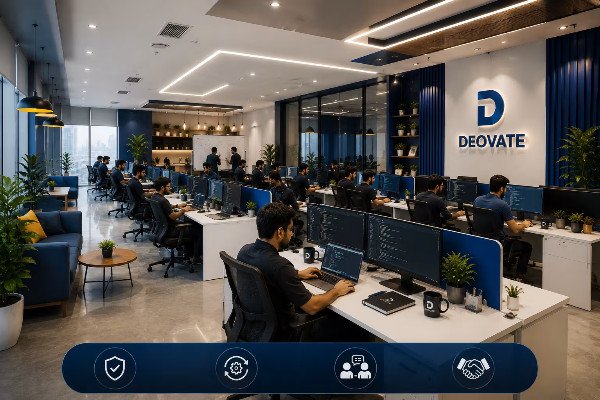
The kind of place people actually want to show up to and do their best work.
Walk through our office and you'll see what we actually believe in, not just what we
say we believe in. People pull up a chair to work through a problem together instead of emailing
it back and forth for two days. Ideas get challenged here, not just agreed with - that's usually
where the better solution comes from.
Everyone owns their work, not just their assigned tickets. If someone spots a
better way to do something, we'd rather hear about it than have them quietly work around it.
That kind of ownership is also, honestly, why the work holds up once it reaches a client - people
who care about getting it right build things that actually work.
Some days it's whiteboards and planning; other days it's heads-down debugging
with headphones on. The office is built to support both - space to think alone, and space to pull
people in when a problem needs more than one set of eyes.
Four things clients mention most often when they're asked why they picked us — and why theystayed.
We push back on a brief before we build it. If a requested feature won't move the numberyou actually care about, you hear that in the planning call — not three sprints in.
We test load times against an average mobile connection, not office wifi — becausethat's where most real users, and most lost sales, actually are.
We design for the moment a user is confused and about to leave, not just the easy firstclick. That moment is usually what decides whether they convert or bounce.
We build assuming your business will look different in two years than it does today —because it will. You shouldn't have to rebuild from scratch every time you pivot.
Discover how our technology solutions have helped businesses innovate, grow, and achieve lasting success through trusted partnerships and measurable results.
You can tell a lot about a company by how they run a discovery call. Deovate's team asked more questions in our first meeting than our previous developer did in six months of work together.
What stood out reading about their team and process was that it actually matched what happened once we signed on. No bait and switch, no junior team suddenly showing up after the sales call ended.
Their focus on honesty over flattery took some getting used to, since I was expecting the usual agency sales polish. In hindsight, that directness is exactly why our project stayed on budget.
I looked at a handful of agencies before choosing Deovate, and their team was the only one that talked about long-term maintenance unprompted, before I even asked about it. That told me they were thinking past the invoice.
Their values page isn't just filler text - we've genuinely experienced the transparency they describe, especially when a feature we requested turned out to be more complex than either of us expected.
Working with a founder-led team made a real difference for us. Decisions happened fast because we were talking to people who could actually make them, not relayed through three layers of account management.
I appreciated that they didn't oversell what a website could do for a business like mine that still runs mostly on referrals. Setting realistic expectations upfront meant I wasn't disappointed later.
Their team culture shows up in small ways - the same two people were on every call from kickoff to launch, which meant I never had to re-explain our business from scratch.
We're a manufacturing business, not exactly a glamorous client, and I half expected to be treated as a lower priority. That never happened once across the entire engagement.
Reading about their mission sounded like typical website copy until I actually saw them turn down a scope addition because it didn't genuinely serve our goals. That's rare enough to mention specifically.
You've seen how we think and how we work. Here's where it turns into your project.
You've read about how we think, who leads the work, and what a project with us
actually looks like day to day. The next step is simple: tell us what you're building, and we'll tell
you honestly whether we're the right fit - and if we are, exactly what that plan looks like.
Still have a question after reading about our team and process? Here are the ones people ask most.
Quick answers to common questions
We're a technology partner, not a project factory. Deovate builds websites, software, and digital products for businesses that want a team that sticks around after launch instead of disappearing once the invoice is paid.
Most agencies hand you a deliverable and move on to the next client. We stay involved - planning, building, and supporting - because we'd rather have a handful of long-term relationships than a long list of one-off projects.
We work with clients across different regions and time zones. Most of our communication happens over calls and async updates, so distance hasn't been a barrier to how closely we work with a client.
We started this company because too many businesses were getting either agencies that talk a good game but under-deliver, or freelancers who vanish mid-project. Our goal is to be the team that's still answering the phone a year later.
Deovate is led by a founder who's hands-on in the day-to-day, not a name on a slide deck. Decisions about how we work with clients and what we build come from people who are actually doing the work, not a distant management layer.
Honesty about timelines and cost, even when the answer is inconvenient. We'd rather tell a client a deadline is unrealistic upfront than blow past it silently - that's cost us short-term deals before, and we're fine with that trade.
We work across a mix - retail and eCommerce, service-based businesses, startups building their first product, and established companies replacing aging systems. The common thread isn't industry, it's businesses that need software to actually solve a problem, not just look good in a pitch deck.
We run as a core in-house team, which is why quality and communication stay consistent from the first call to post-launch support. We're not assembling a new set of contractors for every project.
We work with founders just getting started as much as we work with established companies scaling up. The engagement looks different depending on budget and scope, but the discovery conversation is the same for everyone.
Reach out through the contact form or book a discovery call. There's no sales pitch waiting for you - just a conversation about what you're trying to build and whether we're the right fit for it.
We'd love to hear about your project